
- Home
- Industrial Solutions
- Partners
- Industry 4.0 / Digital Transformation
- Environmental Management
- Industry 4.0 / Digital Transformation
- Environmental Management
- Resources
- About Us
- Contact Us
- Home
- Industrial Solutions
- Partners
- Industry 4.0 / Digital Transformation
- Environmental Management
- Industry 4.0 / Digital Transformation
- Environmental Management
- Resources
- About Us
- Contact Us
Coke Oven
Stronger protection. Zero interruptions.
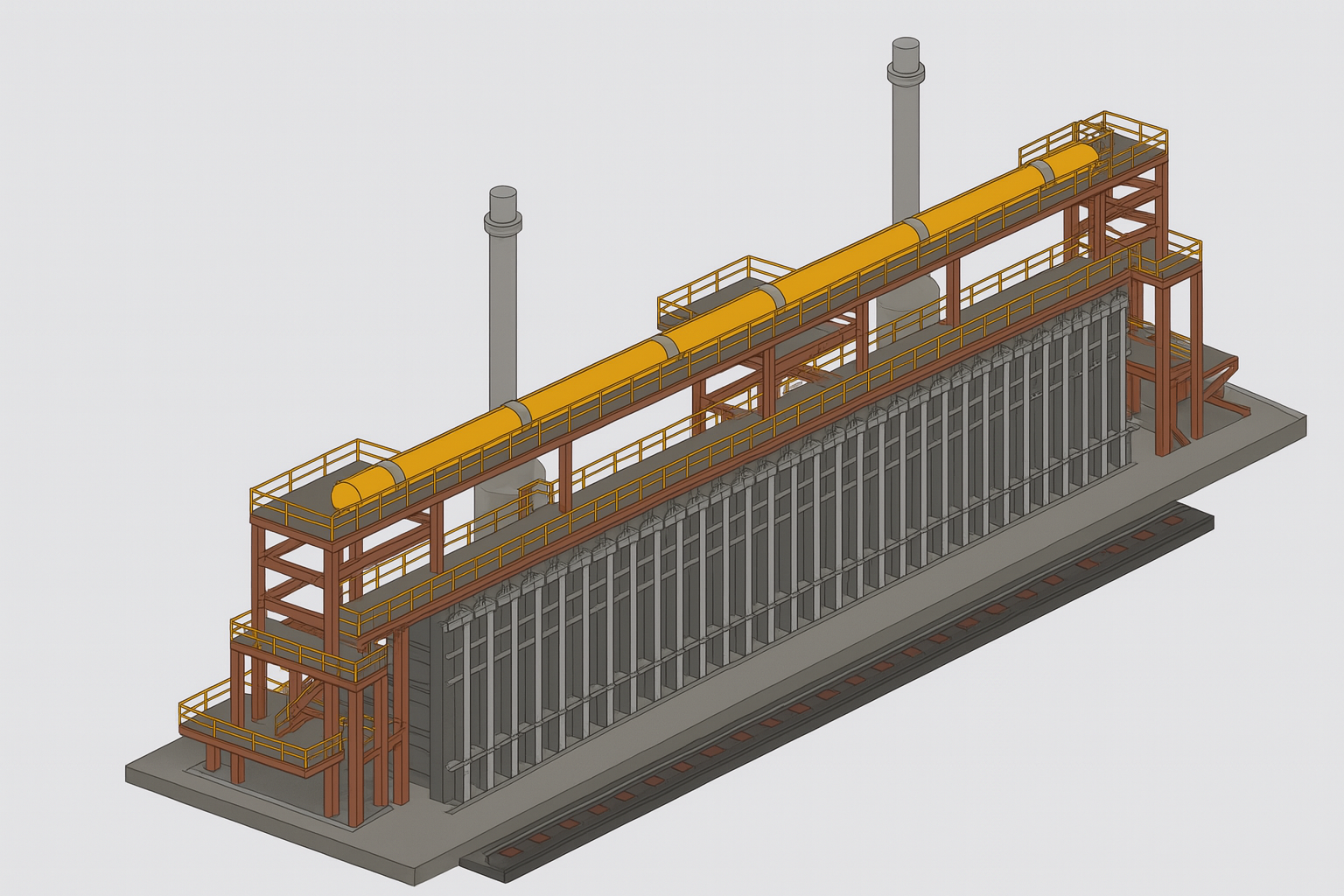
Zone Introduction
The Coke Oven plant produces metallurgical coke — the primary fuel and reducing agent for the Blast Furnace.
Continuous and smooth coke handling is critical because any flow interruption directly affects BF charging schedules and hot metal production.
This zone continuously handles hot, dense, sharp-edged coke lumps — creating a severe wear environment for chutes, screens, and conveyors.
Process Description
After carbonization, hot coke (~200–350°C) is pushed from ovens and transferred through guides, wharf, quenching systems, screens, and conveyors into storage or surge bunkers.
Coke handling involves:
- Large dense lumps fall onto steel → Strong impact loads
- Sharp coke edges rub surfaces → Deep sliding abrasion
- Fine coke breeze → High-velocity erosion & leakage
- Temperature shifts during quenching → Thermal fatigue & cracking
- Coke dust is chemically reactive → Corrosion-abrasion
Flow is nonstop during operations → structural plate thickness reduces rapidly.
Dust and heat together create wear that spreads faster than typical abrasion zones.
As screening and transfer systems choke, mechanical vibration increases → accelerating fatigue failure.
Even 12–20 mm thick plates become bent, holed, or cracked in short periods without engineered liners.
Areas of Wear & Root Causes
Coke screen underpans → High-energy abrasion from sharp fines
Transfer chute walls & lips → Heavy impact gouging
Bunker impact zones → Large lump collision → plate deformation
Belt loading points → Frictional wear & dust erosion
Discharge hoppers → Constant flow → Groove formation
Performance Loss & Downtime Impact
Choking & spillage → Frequent shutdowns & labor cleanup
Transfer leaks → Dust exposure & unsafe environment
Hot plate cracking → Unplanned repair welding
Uneven feeding → BF operational instability
Material loss → Increased cost per ton of coke charged
Delayed BF feeding = direct production loss in steelmaking.
Recommended Products
- Engineered for handling hot coke abrasion
- Maintain plate strength under heat cycling
- Prevents deformation and cracking failures
- Ultra-hard against fines erosion & sliding abrasion
- Dramatically extends life of screens and chute liners